Pocket Alternative & Replacement in 2026: ReadMonkey Pro Migration Guide
Mozilla shut Pocket down on July 8, 2025. The October 8 export window has closed and the API was disabled on November 12, 2025. ReadMonkey Pro is the no-account, privacy-first Chrome extension that syncs your saved articles through Chrome's own infrastructure — not a vendor cloud that can disappear.
 By Zee Calder
TL;DR
Pocket was the world's most popular read-later service for 18 years until Mozilla shut it down on July 8, 2025. Over 10 million users had until October 8, 2025 to export their data; after that, the API was disabled and accounts were queued for permanent deletion. ReadMonkey Pro is a Chrome extension built specifically to replace that vendor-cloud architecture: your saved article text stays on your device and your reading list syncs through Chrome's own sync infrastructure, so there is no PlugMonkey cloud that can shut down on you the same way. No account with us, no usage analytics, your reading is never sent to PlugMonkey, distraction-free reader, 5-color highlighting with notes, and export to JSON / Markdown / HTML / CSV / PDF. Free tier saves 25 articles per week; Pro is $4.99/month, $19.99/year, or $34.99 once for a lifetime license.
- Pocket shut down July 8, 2025; export window closed October 8; all user data is queued for deletion.
- ReadMonkey Pro is the most direct Chrome-native, no-account replacement — it syncs through Chrome's own sync, not a vendor cloud.
- Best for Chrome users on desktop. If you primarily read on iOS/Android, choose Instapaper or Matter instead — they have native mobile apps; ReadMonkey Pro does not.
- Pricing: free for 25 saves/week, $4.99/mo, $19.99/yr, or $34.99 lifetime. The lifetime license costs roughly what one year of Pocket Premium used to.
Pocket Is No Longer Available
Mozilla announced Pocket's shutdown on May 22, 2025 and closed the service on July 8, 2025. The data-export window closed October 8, 2025, after which all user data was queued for permanent deletion. The Pocket API was disabled on November 12, 2025. Mozilla cited a refocusing on Firefox and changes in how people browse and save content. This happened in July 2025.
“Pocket has helped millions save articles and discover stories worth reading. But the way people use the web has evolved, so we're channeling our resources into projects that better match their browsing habits and online needs.”
Why People Need a Pocket Alternative
Pocket shut down permanently on July 8, 2025
Mozilla discontinued Pocket on July 8, 2025 after 18 years of operation. There are no new signups, no downloads, no service. The data-export window closed on October 8, 2025 and the Pocket API was disabled on November 12, 2025 — at which point all user accounts and data were queued for permanent deletion. Anyone who didn't export before October 8 has no way to recover their reading library. This is documented in the official Mozilla support article on the future of Pocket.
Vendor-cloud dependency was the fatal flaw
Pocket stored every article, tag, and highlight on Mozilla's own servers. When the service was killed, the data went with it. The same pattern killed Omnivore — the open-source read-later app — eight months earlier, in November 2024, when its team was acquihired by ElevenLabs and the hosted service was shut down with a two-week export window. The lesson is structural: if a company controls your reading library's only copy, the company controls its fate. ReadMonkey Pro inverts the model by syncing through Chrome's own sync infrastructure, which you already use — there is no PlugMonkey server in the loop.
Privacy was never the priority — even with Mozilla branding
Despite Mozilla's privacy reputation, Pocket's privacy policy disclosed collection of URLs, page content, browser type, device type, and advertising identifiers. Users could not opt out of tracking, even as paying Premium customers. ReadMonkey Pro has no usage analytics or telemetry, no account on our side, and no third-party tracking; your reading is never sent to PlugMonkey. The data lives where you already store browser data.
Cloud-first meant internet-required
When Pocket's servers went down — and they did, repeatedly, in the months leading up to the shutdown — your reading list was inaccessible. ReadMonkey Pro stores article text in Chrome's local storage, so your library is always available locally even when offline. Chrome Sync replicates the reading list and highlights across your signed-in browsers when you're online, but losing connectivity never locks you out.
The Numbers Behind Pocket
Every figure below cites a primary source. Click through to verify.
Users Mozilla reported in its May 2025 shutdown announcement (Pocket had grown from 17M users and 1B+ saves by September 2015 to a smaller but still substantial active base by 2025).
Source: Mozilla2025
Pocket's total operating lifespan, from its 2007 founding as Read It Later through Mozilla's 2017 acquisition to the July 2025 shutdown.
Source: Wikipedia / Mozilla2025
Date the Pocket API was disabled. After this, all user accounts and saved data were queued for permanent deletion. The 30-day export window before this had ended on October 8.
Source: Mozilla Support KB2025
ReadMonkey Pro vs Pocket
Feature-by-feature comparison
| Feature | ReadMonkey Pro | |
|---|---|---|
| Status | Shut down July 8, 2025 | Active, maintained (v1.3.8) |
| Data storage | Mozilla cloud servers (deleted Nov 2025) | Chrome's own sync — no vendor cloud |
| Account required | Yes — Mozilla / Firefox account | No — works immediately on install |
| Privacy / tracking | Tracked URLs, content, device, ad IDs | No usage analytics or telemetry |
| Platforms | Web, iOS, Android, Mac, Kobo | Chrome desktop only (no mobile app) |
| Monthly cost | Was $4.99/mo Premium | $4.99/month |
| Lifetime option | Never offered | $34.99 one-time payment |
| Highlighting | Basic (Premium only) | 5 colors with inline notes (Pro) |
| Export formats | HTML export (window now closed) | JSON (Free); Markdown, HTML, CSV (Pro) |
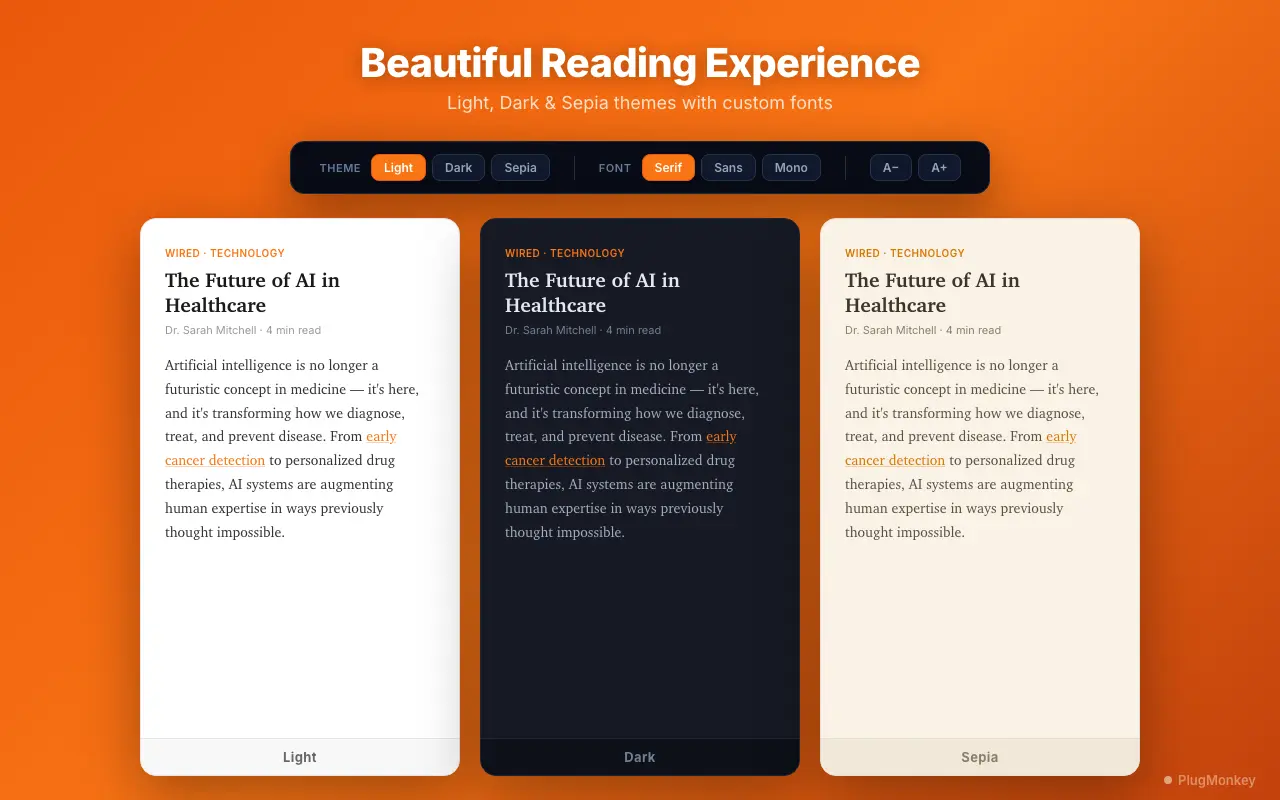
| Distraction-free reader | Yes | Yes — light/dark/sepia + adjustable typography |
| Offline reading | Required server sync first | Fully offline — local Chrome storage |
| Article discovery feed | Pocket Discover (curated recommendations) | Not offered — ReadMonkey Pro is a save/read tool, not a discovery platform |
Pricing: ReadMonkey Pro vs Pocket
Pocket Premium was $4.99/month or $44.99/year. The service shut down July 8, 2025 — no longer available at any price.
- Subscription-only pricing
- Lose access when you cancel
ReadMonkey Pro
ReadMonkey Pro's $34.99 lifetime license costs roughly what Pocket Premium charged for a single year. Pay once instead of renting access to a service that can disappear.
30-day refund if it doesn't work as described
Still Deciding?
Get an independent AI perspective on which tool is the better fit for you.
AI responses are generated independently and may vary
Honest Recommendation
If you primarily read on iOS or Android, ReadMonkey Pro is not the right tool.
ReadMonkey Pro is a Chrome extension. It runs on desktop Chrome (and Chromium browsers like Edge, Brave, Arc) but there is no native iOS or Android app. If your reading happens on a phone or tablet — commuting, before bed, on the couch — you'll want a tool with first-class mobile apps and background sync. That's not what we built.
Use instead: Instapaper or Matter. Both have polished iOS and Android apps with offline sync and read-aloud. Instapaper has been the gold-standard read-later app since 2008; Matter is the modern, design-forward option with stronger AI features. Read our Instapaper alternative breakdown.
Is ReadMonkey Pro Right for You?
Switch If You...
- You used Pocket on Chrome desktop and need a like-for-like replacement after the shutdown.
- You want a read-later tool whose data lives in infrastructure you already use, not a third-party cloud that can be killed by a corporate decision.
- You care about privacy and don't want your reading history sent to any analytics or ad system.
- You want a lifetime-license option so a future shutdown won't cost you ongoing payments.
- You need multi-format export (Markdown, HTML, CSV) to feed your Obsidian vault, Notion workspace, or research database.
- You want 5-color highlighting with inline notes — not just plain saves.
Consider Other Options If You...
- You primarily read on mobile — Instapaper or Matter have native apps; ReadMonkey Pro does not.
- You loved Pocket Discover's curated recommendation feed — ReadMonkey Pro is a saving and reading tool, not a content discovery platform. Try Raindrop or Matter for discovery.
- You read on a Kobo e-reader and used Pocket integration — Kobo's own Pocket-replacement feature plus a tool like Readwise Reader is a better fit.
- You need team or shared collections — try Raindrop, which has built-in collaboration.
Your reading library shouldn't depend on a company's survival.
ReadMonkey Pro: save articles with Chrome Sync, read distraction-free, highlight in 5 colors, export to Markdown/HTML/CSV. No account, no vendor cloud, no usage analytics.
Frequently Asked Questions
What's the best alternative to Pocket?
ReadMonkey Pro wins on the architectural lesson Pocket taught: don't put your reading library inside another vendor's cloud. Because ReadMonkey Pro syncs your reading list through Chrome's
chrome.storage.sync API rather than a PlugMonkey server, there is no proprietary cloud that can be shut down the way Mozilla shut down Pocket. We've also priced it for the long term — $34.99 buys a lifetime license, roughly what one year of Pocket Premium used to cost.What is a good replacement for the Pocket app?
The replacement landscape has stabilized since the July 2025 shutdown. The four most-cited alternatives in current coverage are Instapaper, Raindrop, Matter, and Omnivore (self-hosted forks). Pick by reading device first: desktop Chrome → ReadMonkey Pro; phone/tablet → Instapaper or Matter; cross-platform with collections → Raindrop.
Why is Pocket being discontinued?
Industry coverage from TechCrunch, Nieman Lab, and MacRumors reads the move as Mozilla narrowing its bets back to Firefox-core engineering after years of side acquisitions. Pocket had been Mozilla-owned since 2017 and had operated for 18 years total, dating back to its 2007 founding as “Read It Later.”
What to use now that Pocket is shutting down?
If you still have an unexported Pocket archive sitting around, there is unfortunately nothing to import from any longer — the export window closed October 8, 2025 and Mozilla disabled the API on November 12, 2025. If you exported in time, you can re-import that HTML file into Instapaper, Raindrop, or Wallabag, all of which accept Pocket's export format. ReadMonkey Pro does not import Pocket exports yet.
Does Chrome have a built-in read later feature?
Chrome's native Reading List is fine for “come back to this in a few hours.” It's not a replacement for Pocket if you actually want to read and annotate. ReadMonkey Pro is built on top of Chrome's storage layer in much the same way Reading List is — same sync infrastructure — but adds the full distraction-free reader, highlighting, notes, tagging, and multi-format export.
What is the shortcut for read later in Chrome?
chrome://extensions/shortcuts. Many users assign Ctrl+Shift+D (or Cmd+Shift+D on Mac) to their read-later extension of choice.ReadMonkey Pro registers a configurable shortcut for “Save current page” that you can set the same way. The default suggested binding is Ctrl+Shift+S / Cmd+Shift+S, but you can change it to whatever doesn't conflict with your other extensions. The shortcut works on any page and saves the article instantly to your local library without opening any UI.
Is Kobo replacing Pocket?
If you read on a Kobo e-reader, your best 2026 path is to pair a desktop read-later tool with a service Kobo officially supports for sending articles to the device. ReadMonkey Pro doesn't have direct Kobo integration — it's Chrome-only on the device side. For Kobo users specifically, Instapaper (which has direct Kobo article-sending) or Readwise Reader is a better fit.
Can I import my Pocket export into ReadMonkey Pro?
The honest answer is that ReadMonkey Pro is younger than the Pocket shutdown, so the import flow wasn't a launch priority. We've published a step-by-step migration guide at How to Migrate from Pocket to ReadMonkey Pro covering the workarounds (Raindrop/Instapaper intermediate) until native Pocket import lands. If migrating today is critical for you, we suggest starting fresh with ReadMonkey Pro for new saves and using Raindrop as a one-time home for your historical export.
Is there a free Pocket alternative that doesn't require an account?
Of the major Pocket alternatives, ReadMonkey Pro is the only widely-available option that combines “free tier” with “no account.” Instapaper has a free tier but requires an Instapaper account. Raindrop has a free tier but requires a Raindrop account. Self-hosted Wallabag is free but requires running your own server. If your reason for leaving Pocket is partly that you're tired of signing up for things, ReadMonkey Pro is the most direct match for that preference.
What is the best Pocket alternative for Android or iOS?
ReadMonkey Pro is honestly not the right tool if you read primarily on a phone or tablet — it's a Chrome desktop extension and there's no mobile app on our roadmap. We'd rather tell you that up front than have you install and uninstall in the same week. For cross-platform users who read on both desktop and mobile, Raindrop is the most balanced choice — it has solid apps on every platform and a free tier.
Sources & Further Reading
- Pocket has shut down — What you need to know (official Mozilla Support KB) — Mozilla Support (accessed May 22, 2026)
- Investing in what moves the internet forward (Mozilla's May 22, 2025 announcement) — Mozilla Blog (accessed May 22, 2026)
- Mozilla is shutting down read-it-later app Pocket — TechCrunch (accessed May 22, 2026)
- Firefox Maker Mozilla Discontinues Pocket and Fakespot to Focus on Browser — MacRumors (accessed May 22, 2026)
- Mozilla is shutting down Pocket, its read-it-later app — Nieman Journalism Lab (accessed May 22, 2026)
- Pocket (service) — historical overview and acquisition timeline — Wikipedia (accessed May 22, 2026)
- Mozilla shutdowns Pocket service after 18 years — PPC Land (accessed May 22, 2026)
- Shutdown of Pocket service (Mozilla community discussion thread) — Mozilla Discourse (accessed May 22, 2026)